The P³ Method™ in Action
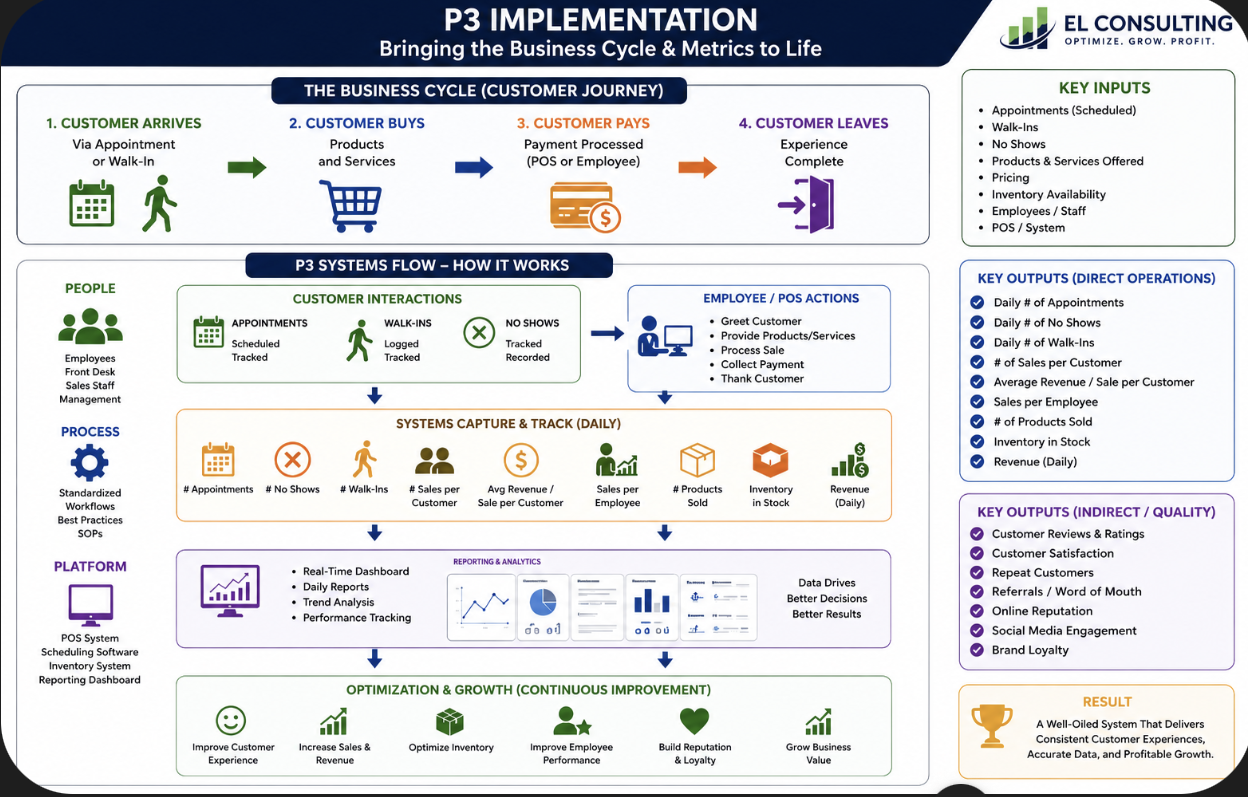
Every business follows a predictable cycle. Customers arrive, purchase products or services, pay, and leave. Most businesses stop there. The P³ Method™ goes further by transforming each step into a measurable system that captures the data needed to improve performance, profitability, and the customer experience.
When processes are documented, performance metrics are tracked, and platforms work together, owners gain something far more valuable than reports—owners gain control of their business.
The P³ Reinforcement Principle
The P³ Reinforcement Principle
When we implement a new process, the process is fragile. Managers are already overwhelmed with dozens of competing priorities. Every day, they subconsciously ask themselves one question:
“What does the owner really care about?”
They don’t answer that question by listening to what the owner says.
They answer it by watching where the owner directs their attention.
If the owner never asks about appointment conversion…
It must not matter.
If the owner never reviews the dashboard…
It must not matter.
If the owner never mentions customer reviews…
It must not matter.
If the owner never follows up on inventory counts…
It must not matter.
Within weeks, everyone quietly reverts to their old habits.
Owners create culture by what they consistently reinforce—not by what they announce.
If a critical process isn’t being followed, the first place to look isn’t the employee—it’s the reinforcement system created by leadership.
Example one
The owner implements the process
↓
The manager starts the process
↓
Owner stops asking
↓
Manager shifts attention
↓
Process weakens
↓
Performance declines
↓
The owner blames the manager
↓
Reality...
The owner unintentionally stopped reinforcing the process.
Example Two
The owner implements the process
↓
Manager implements
↓
The owner asks every week
↓
Dashboard reviewed
↓
Success celebrated
↓
Problems corrected
↓
Process becomes habit
↓
Habit becomes culture
People support what leaders consistently reinforce.
Attention is the currency of leadership. Wherever the owner consistently invests attention, management follows.
That’s why managers suddenly care when the owner asks about something every Monday morning.
“Six months after I leave, what will convince your managers that this process is still important?”
If the answer is nothing, then the process has already failed.
If the answer is:
- “The owner asks every week.”
- “It’s on the dashboard.”
- “It’s reviewed in every management meeting.”
- “It’s part of every employee evaluation.”
Then the process has a chance to become permanent.